With all the current focus on Holy Week and Easter this year, it would be very easy to miss another important date in the history of the Cathedral of Santiago de Compostela. Monday, April 21, marks the 814th anniversary of the consecration of the Cathedral of Santiago de Compostela. Construction of the current church building was begun in the late 11th c. and finished in 1211.
That consecration event, which would transform the new structure into a functioning church, would have been one not to miss. King Alfonso IX of León attended with his brother, Sancho, and his young son, now known to us as San Fernando. In many ways, the events of consecrating the new church would have followed proscribed rituals that had been in practice for centuries. After all, even now, one does not simply build a new church and start practicing one’s faith within it without some bit of canonical magic to solidify that the new space is now holy enough to say Mass, distribute the Eucharist, join couples, baptize their children, and bury their dead.
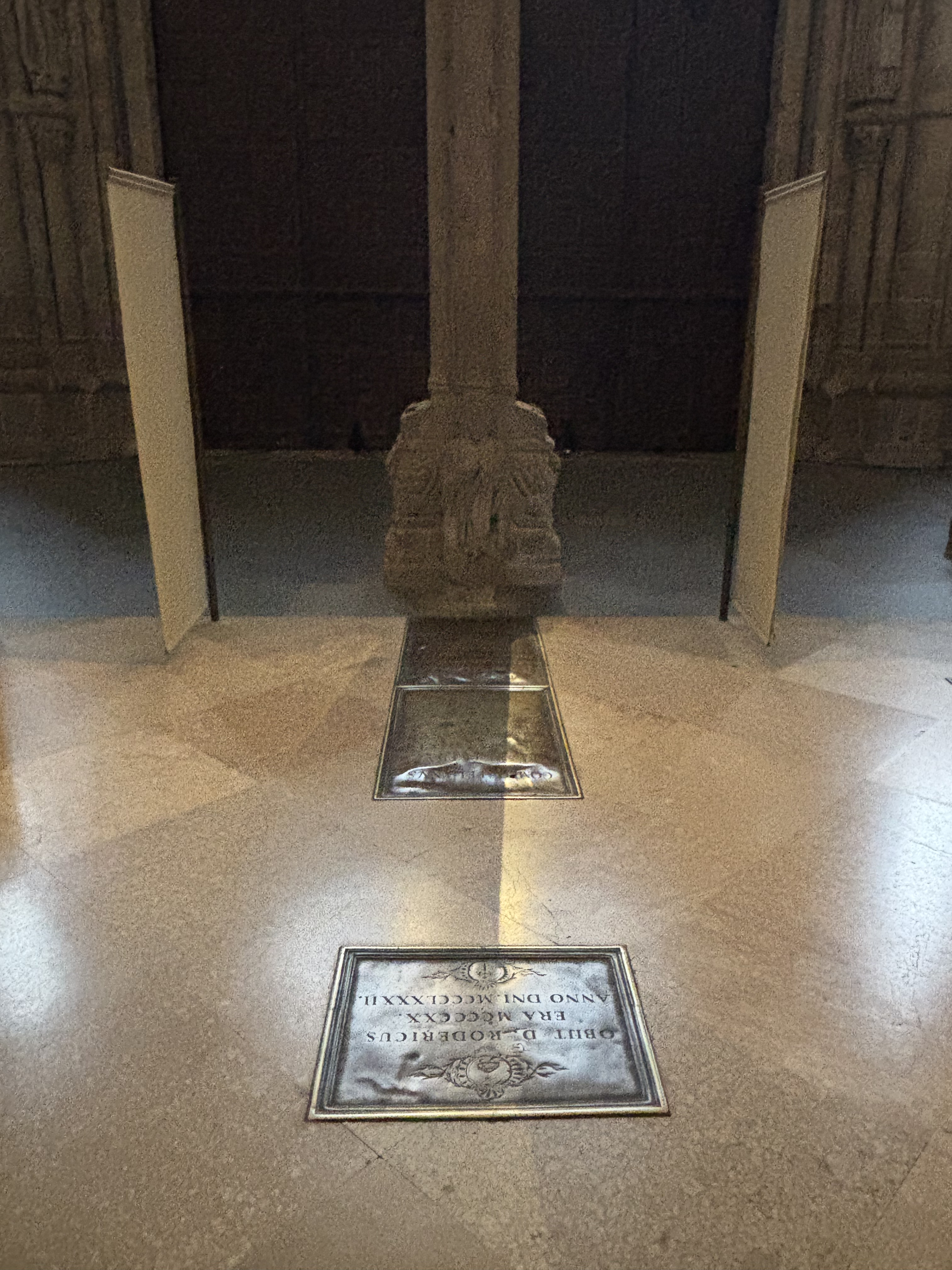
But what is particularly interesting about this consecration is that the man who was responsible for that magic was considered himself to be a magician. He was even removed from his post as archbishop of the Cathedral for a time, in the vain hope that he might come around and suddenly give up necromancy. His name? He called himself Pedro IV, because he was the fourth bishop of Santiago to carry the name Pedro. He is commemorated in the Cathedral in a bronze floor plaque directly behind the Portico de la Gloria near the west end of the church.
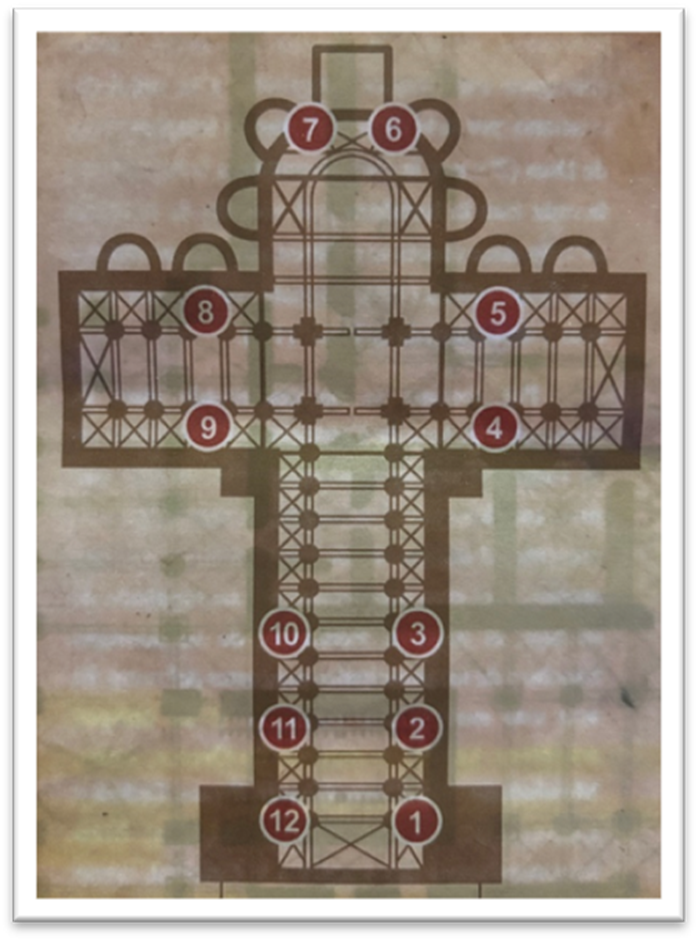
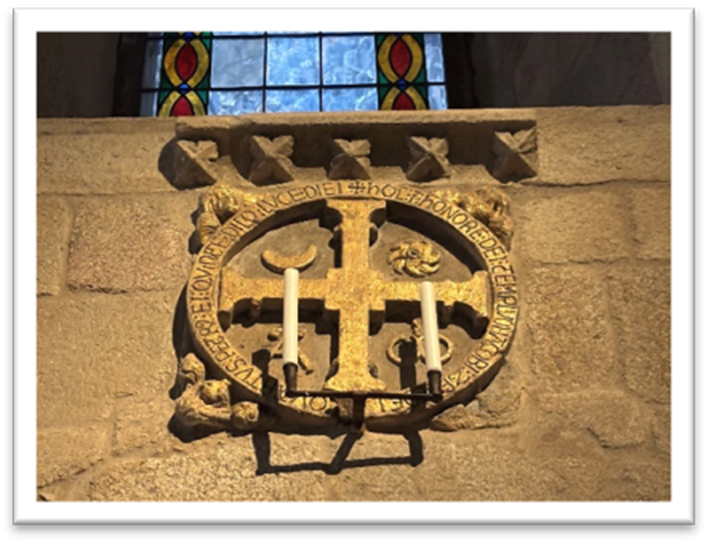
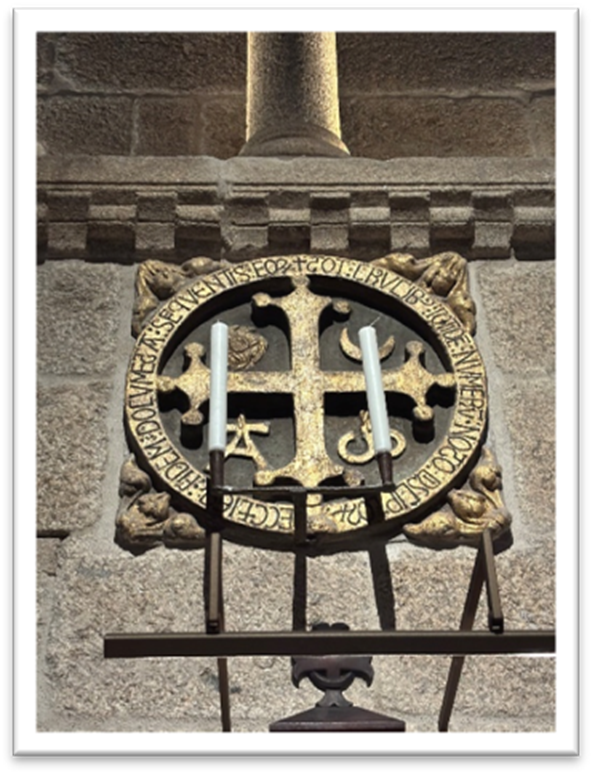
What makes this bit of Cathedral history fun is that the details of the consecration are hidden in plain sight today. To memorialize the event in 1211, a dozen discs were set in place on the walls of the new church. They each have at the center a Jerusalem cross, the alpha and omega, and images of the sun and the moon. The key components of the story of the consecration itself are there as well, in short Latin inscriptions that surround the discs. There are also several references to this new church being dedicated to honor Santiago and Jesus, the Son of David.
But they also answer the key questions. (The map identifies the location of each disc).
Who consecrated the building?
That would be Pedro IV – and he claims that honor on Discs 5, 9, and 12. He is also mentioned on Discs 4, 7, and 8, lest you miss seeing who was responsible.
When did this event take place?
That’s on Disc 7 – it was a Thursday, in our calendar April 1211. And it was precisely the 19th day after Easter that year.

So, I give up, why are there twelve discs and not 6 or 9 or more?
I could guess it was because there are twelve Apostles of Jesus, but it says exactly that on Disc 10.
For one day in the Cathedral calendar every year, two white candles are lit to recall the consecration. This year, it’s Easter Monday, April 21. The rumor is, and I take this one seriously, that the candle sconces themselves are original to the discs. Meaning, also 814 years old.
When you’re in the gift shops, you can pick up small souvenir copies of the discs. And perhaps, you will also think of Archbishop Pedro IV and wonder if the stories of his magical abilities are true. They say he found the Philosopher’s Stone, so he may not be buried in the Cathedral after all.
If you’d like to read more stories of the people who have been in the Cathedral of Santiago de Compostela, consider ordering my guide to the Cathedral for pilgrims, “If You Stand Here.” Link in “My Books.”
 Tumbleweed Pilgrim
I noticed those but had no idea what they were!
I really enjoyed your book “If You Stand Here.” Hope to return to Santiago someday and use it as a guidebook.
LikeLike
Es muy enriquecedor ese ‘A Story Hiding…’ que agradezco y por el que felicito a su confeccionador, ¡Feliz Pascua 2025!
LikeLike